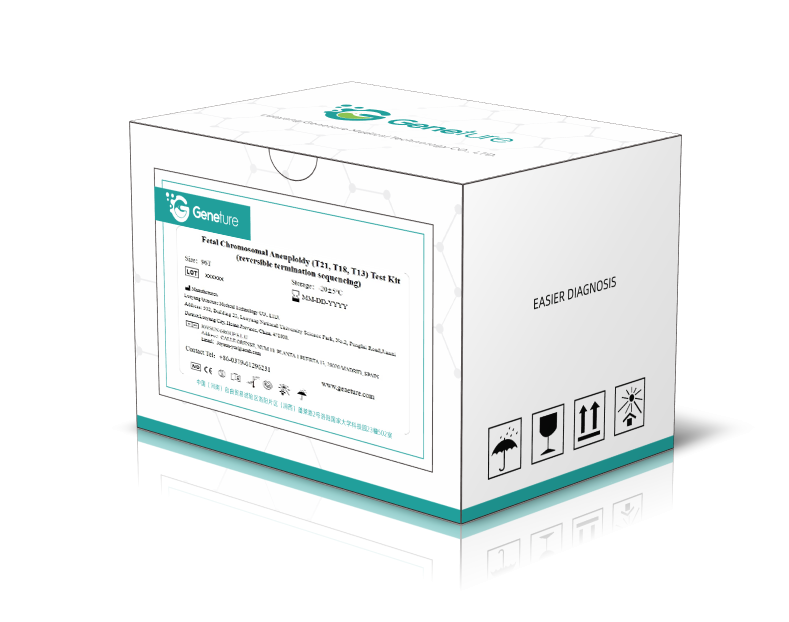
Fetal Chromosomal Aneuploidy (T21, T18, T13) Test Kit (reversible termination sequencing)
Trisomy 21, trisomy 18 and trisomy 13 are the most common chromosomal aneuploidies in clinical practice. The corresponding diseases are trisomy 21 (also known as Down syndrome), trisomy 18 (also known as Edwards syndrome) and trisomy 13 (also known as Patau syndrome), with an incidence of about 1/700, 1/6000 and 1/10,000, respectively. Most of the patients had severe mental retardation and organ malformations. Prenatal screening and prenatal diagnosis are effective means to avoid the birth of children with genetic defects.
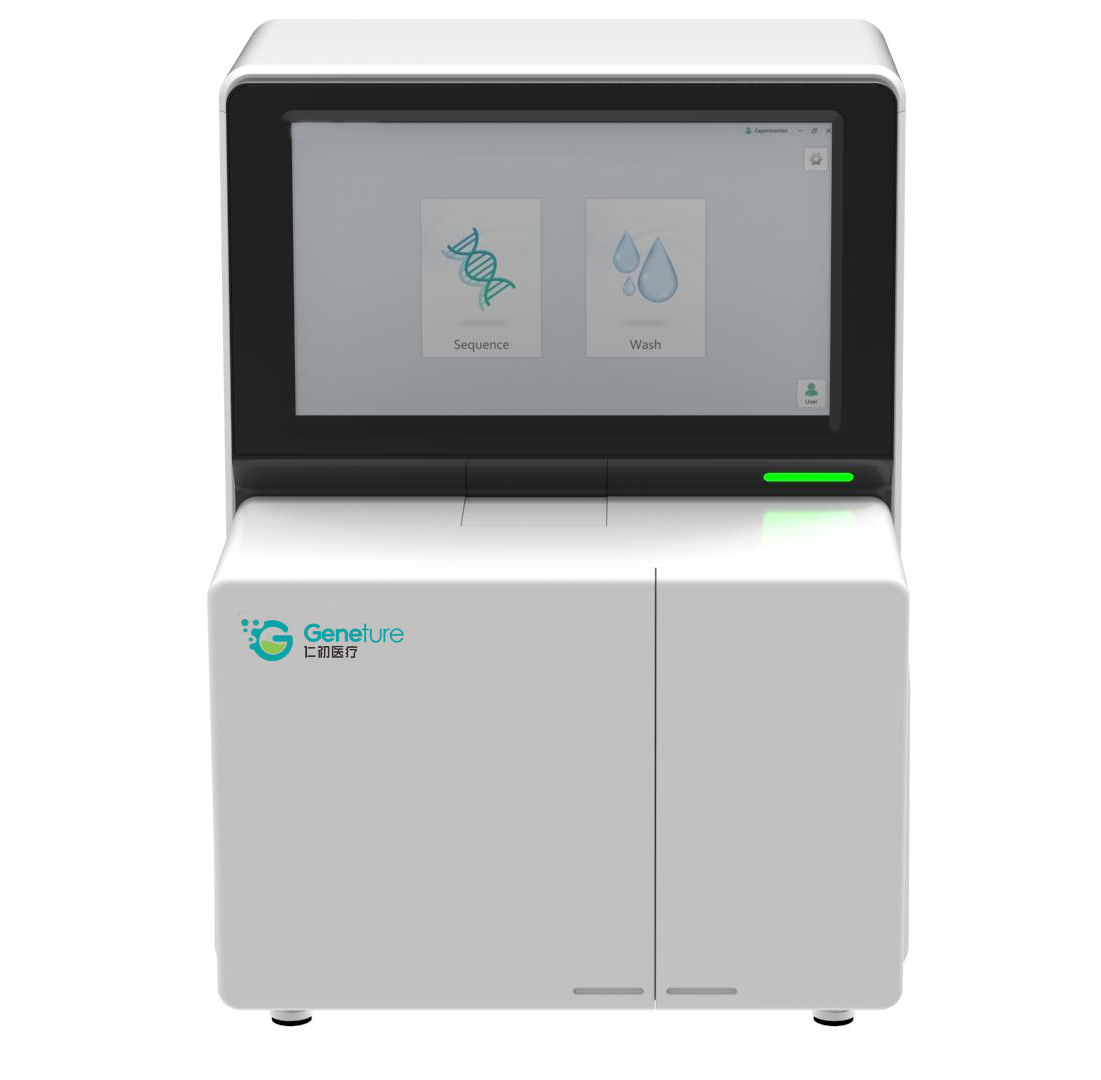
Cell-free fetal DNA(cffDNA) exists in maternal peripheral blood. The content of cffDNA in maternal plasma has a certain relationship with gestational age, and fluctuates within a certain range. When the number of a chromosome in the fetus is abnormal, the proportion of cffDNA in that chromosome will exceed the normal range. By sequencing, we can calculate the proportion of DNA fragments in the plasma of each chromosome, and thus obtain information about the number of chromosomes. Based on the above principle, Geneture Fetal Chromosomal Aneuploidy (T21, T18, T13) Test Kit uses the next generation high-throughput sequencing platform to detect fetal cell-free DNA in peripheral blood plasma of pregnant women at 12+ 0~22 +6 gestational weeks, and complete the prenatal screening of fetal chromosomal aneuploidies including T21, T18 and T13.
Model:96T
- SKU: 0207011
- Category: Geneture Gene Sequencing Kit
Product Features:
1) High Library Quality: Includes a complete set of reagents for library preparation, purification, and sequencing; the library construction failure rate of the kit is ≤1%.
2) Precision: <5%.
3) Sensitivity: At a DNA concentration of 1.67 ng/mL, the minimum detectable percentage of fetal DNA is 3.5%.
4) High Accuracy: A multi-dimensional calibration strategy is employed to further reduce the false-negative and false-positive rates.
5) Strong Anti-interference Capability.
6) High Cost-effectiveness:A single test can detect 26/104 types of chromosomal diseases.
Storage Condition:
The reagent was composed of three parts, Part1, Part2 and Part4 need to be transported at -15 ℃ to -20 ℃ and valid for 6 months at -20±5 ℃ when it was unopened. Part3 and Part5 needs 2~8℃ constant temperature transportation, valid for 6 months at 2~8℃ when it was unopened. Once the kit was opened, it was valid for 2 month under the corresponding temperature.
Additional Information
Using the kit to detect the results of fetal T21, T18, and T13, the standard red sample was 21-trisomy, and the rest of the samples were low-risk for T21, T18, and T13.
Clinical Data Summary:
Chromosomal Abnormality | Total High-Risk Cases | Number of Puncture Samples | True Positive | No Abnormality Seen | PPV | Sensitivity | Specificity | FPR |
13 | 228 | 200 | 127 | 73 | 63.5% | 99.22% | 99.99% | 0.0138% |
18 | 760 | 693 | 593 | 100 | 85.57% | 99.66% | 99.98% | 0.0189% |
21 | 2259 | 2182 | 2068 | 114 | 94.78% | 99.66% | 99.98% | 0.0216% |
Total | 3247 | 3075 | 2788 | 287 | 90.67% | 99.64% | 99.96% | 0.0381% |
Send an Inquiry
Your email address will not published. Required fieled are marked.
Related Products
Check out other related DNA/RNA Extraction Products